

Small-molecule development programs have to show FDA how they assessed QT prolongation and cardiac repolarization risk. The work runs from hERG and in vivo telemetry studies under ICH S7B, through clinical QTc assessment under ICH E14, and into postmarketing and labeling. The 2022 E14/S7B Q&A lets sponsors use integrated nonclinical data as part of a risk assessment, sometimes in place of a thorough QT study. Teams planning a program need to know how FDA reviewers have actually applied these options in recent approvals. That precedent shapes study design, the size of safety margins, and how a nonclinical signal gets explained in a submission.
The analysis below covers novel small-molecule NME NDAs with Drugs@FDA decision dates from September 2023 through September 2026. It draws on FDA pharmacology/toxicology reviews and clinical review documents. Nonclinically, it looks at hERG safety margins, in vivo telemetry, ECG findings in repeat-dose studies, and the use of ion-channel, stem-cell cardiomyocyte, in silico and ex vivo assays beyond hERG. Clinically, it covers TQT studies, concentration-QTc modelling, ECG monitoring in patient studies, and waivers, broken down by approval year. It also reports QT-related postmarketing actions and how often nonclinical signals matched clinical QTc outcomes. It states where results rest on only partial review coverage.
Cardiac Safety Pharmacology for New Drugs: How FDA Assessed QT Risk from hERG to Postmarketing (2023–2026)
Key findings
- The hERG assay is nearly universal. A measured IC50 is not. Of 81 small-molecule NMEs with an FDA pharmacology/toxicology review, 74 (91%) reported a hERG result. Only 35 of the 63 with a derivable margin had an IC50 that was actually reached. The other 28 margins are lower bounds, usually because the compound hit its solubility limit first (for example vepdegestrant, linerixibat and aficamten) 286325982559.
- Most margins are large. Of the 63 derivable margins, 38 exceed 100×. Twelve fall below 30×, and eight of those are measured margins. Dordaviprone (4-fold) and etripamil (0.8×) are at the low end 20152554.
- Non-hERG electrophysiology appears in a minority of reviews. Cav1.2 and Nav1.5 are the most common. Late sodium current, hiPSC-cardiomyocyte and in silico proarrhythmia data are rare, and no review in this set reported a formal CiPA model. Where FDA did use these assays, it was mostly to put a hERG signal in context. Examples are the rabbit ventricular wedge for revumenib and gepotidacin and the balance of hERG and Cav1.2 block for ziftomenib 155516142123.
- Dedicated TQT studies are declining. A TQT was the primary clinical QT approach for 55% of 2024 NMEs, 37% in 2025 and 28% in 2026 to date. Over the same period, ECG analyses in patient studies and waivers grew. In oncology, FDA frequently accepted an "alternative QT study" when a TQT was not feasible (ICH E14 Q&A 6.1) 470045785185.
- The 2022 E14/S7B Q&A integrated nonclinical pathway is in use but still uncommon. FDA explicitly folded hERG and in vivo data into its integrated QT risk assessment for 19 of 94 NMEs. In 7 of those, nonclinical data formally helped replace a TQT: levacetylleucine, acoramidis, etripamil, difamilast, linerixibat, orforglipron and florquinitau F-18. Four of the seven were approved in 2026 1261421749312697504651133188.
- QT-related postmarketing actions are uncommon. Five NMEs received a QT-related PMR or PMC: gepirone, revumenib, treosulfan, tradipitant and camizestrant 34594136132949713245. Twelve had QTc prolongation in Warnings and Precautions at approval. The only post-approval QT escalation found was revumenib's boxed warning, added in an October 2025 supplement 42934289.
- Nonclinical signals are better at ruling out than ruling in. In the 64 drugs where both the nonclinical and clinical outcome could be classified, a nonclinical signal had about 55% sensitivity and 77% specificity for clinical QTc prolongation. The negative predictive value was about 89%. Five drugs with no nonclinical signal still prolonged QTc clinically.
Cohort and evidence coverage
The cohort is every original NDA that Drugs@FDA classifies as Type 1 or Type 1/4 (new molecular entity) with a decision date from September 1, 2023 to September 30, 2026. That gives 113 distinct NMEs once iomeprol's two NDAs are merged. Nineteen were excluded as not small molecules:
- nine peptides (for example motixafortide, zilucoplan, elamipretide and icotrokinra)
- eight oligonucleotides (for example nedosiran, eplontersen, imetelstat and plozasiran)
- two polymer or botanical products: birch triterpenes and berdazimer
That leaves 94 small-molecule NMEs, including five diagnostic imaging agents and several fixed combinations where the NME is one component.
Pharmacology/toxicology review coverage: 81 of 94 (86%). The other 13 split into two groups:
- No FDA review documents yet in Drugs@FDA (7): elinzanetant, oveporexton, iberdomide, daraxonrasib, brepocitinib, camizestrant and floretyrosine F 18. All were approved between October 2025 and September 2026.
- Review documents available but no retrievable safety pharmacology content (6): taurolidine (with heparin), tovorafenib, iomeprol, aceclidine, copper histidinate and milsaperidone.
Which figures rest on partial coverage:
- All 81 reviewed NMEs: every nonclinical figure (hERG, telemetry, repeat-dose ECG, non-hERG assays), the concordance grid and the lifecycle flow. These cover 86% of the cohort.
- All 94 NMEs: the clinical QT approach by year and the postmarketing counts. For the 13 NMEs without a review, the clinical approach comes from labeling or other available documents. Ten NMEs are coded "not reported" because no approach could be identified.
Nonclinical characterization (ICH S7A/S7B)
hERG IC50 reporting and safety margins
Seven of the 81 reviews had no usable hERG result:
- For gepirone, FDA stated that no hERG assay was conducted for the parent or its metabolites 127.
- For tebipenem, the hERG study failed because the positive control did not inhibit the current 2898.
- For flurpiridaz F-18, safety pharmacology was not required at a microgram mass dose. The applicant ran hERG, Purkinje fibre and wedge studies anyway, but no IC50 was reported 1250.
Margins below are hERG IC50 divided by unbound clinical Cmax, as stated or directly computable from reviewer text.
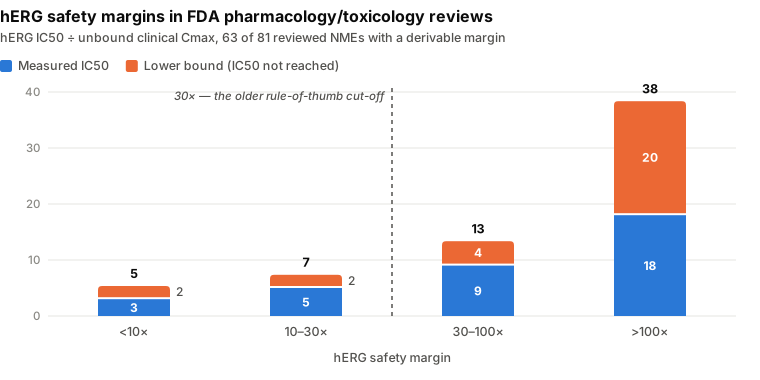
Measured margins below 30×:
- dordaviprone, 4-fold 2015
- etripamil, 0.8× 2554
- ziftomenib: the reviewer stated that the GLP hERG data suggest QT risk at therapeutic exposure 2123
- revumenib, about 12× 1555
- vanzacaftor, about 11× 1371
- taletrectinib, about 14× 1635
- sunvozertinib, about 20× 1671
- sevabertinib, about 26× 2302
Lower bounds below 30× (treosulfan, gedatolisib, arimoclomol, levacetylleucine) are not signals. The IC50 was simply not reached at the concentrations that could be tested 130912651102.
Very large margins (above 10,000×) cluster in topical or poorly absorbed products, for example delgocitinib and linerixibat 19052598.
In vivo cardiovascular telemetry
53 of the 81 reviews described an in vivo cardiovascular safety pharmacology study. Dog was used most often (40 reviews), then cynomolgus monkey (12 or more), rat (4) and minipig (1). Some programs used two species.
Dog studies with QT/QTc prolongation (about one in six):
- capivasertib, sustained QTcR increase of 12% at 40 mg/kg 478
- inavolisib 1171
- revumenib 1571
- sevabertinib 2136
- zoliflodacin 2330
- zidesamtinib, up to +22 ms at 3.6-fold high clinical exposure 2935
- remibrutinib, a short repeat-dose dog study 2241
Monkey studies with QT/QTc prolongation (about four in 13):
- imlunestrant, where the FDA reviewer disagreed with the applicant's negative reading of a 3-month telemetry study 2275
- relacorilant 2520
- baxdrostat 2763
- gepotidacin, in a conscious monkey cardiovascular study 1612
For sebetralstat, monkey telemetry was negative, but the reviewer concluded that QTc prolongation potential could not be ruled out 1926.
ECG findings in repeat-dose toxicology
43 of 81 reviews described ECG collection in repeat-dose toxicology studies. Findings fell into four groups:
- No drug-related changes: 27 reviews.
- QTc prolongation that reviewers treated as drug-related: 8 reviews: capivasertib, iptacopan, revumenib, ensartinib, imlunestrant, remibrutinib, aficamten and arimoclomol 483638156815022279224125291265.
- Single-animal QTc outliers that reviewers discounted: vorasidenib and ensitrelvir 11302795.
- Heart-rate or interval changes secondary to heart rate: danicopan, zoliflodacin, ziftomenib, doxecitine/doxribtimine and brensocatib 7192330212021931994.
Beyond hERG: other ion channels, stem-cell, in silico and ex vivo models
33 of 81 reviews (41%) reported at least one non-hERG cardiac electrophysiology assay.
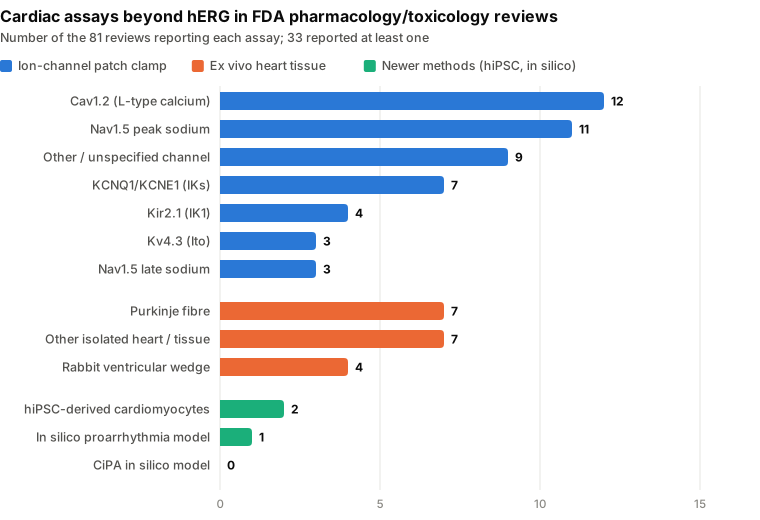
- Late sodium current was reported only for treosulfan, gepotidacin and etripamil 130916122554.
- hiPSC-cardiomyocyte data appeared twice:
- In silico modelling: no review reported a CiPA in silico model. The only one was a statistical torsade-risk model (Kramer et al.) that the landiolol sponsor applied to its multi-channel panel 1576.
FDA used non-hERG data to interpret a hERG signal in about eight reviews:
- Revumenib: rabbit wedge torsade scores of 2.5 at ≥3 μM were read as consistent with the hERG margins 1555.
- Gepotidacin: dose-dependent QT prolongation in the wedge was attributed to hERG block 1614.
- Lazertinib: an isolated rabbit heart study supported very low proarrhythmic potential despite measurable hERG inhibition 12891290.
- Ziftomenib: logistic-regression modelling of comparable hERG and Cav1.2 potencies indicated low torsade risk 2123.
- Etripamil: the IRT read increased heart rate, longer PR and decreased QTcF in the clinic as consistent with its hERG, Cav1.2 and Nav1.5 profile 4931.
Clinical characterization (ICH E14)
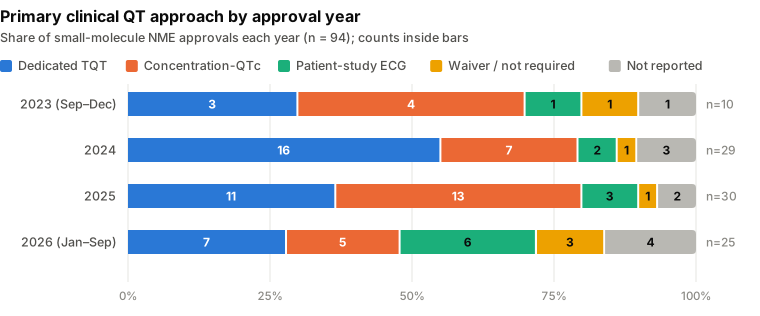
In 2025, concentration-QTc overtook the TQT as the most common primary approach. In 2026 to date, ECG analyses in patient studies and waivers together account for 36% of approvals.
In oncology, FDA repeatedly treated patient-study data as an alternative QT study when a TQT was not feasible (ICH E14 Q&A 6.1). Examples:
- taletrectinib and lazertinib: phase 1 concentration-QTc 47003963
- zongertinib and sonrotoclax: FDA stopped short of a negative conclusion 45785185
- vepdegestrant: phase 3 QT substudy 5232
- revumenib and ziftomenib: pooled patient concentration-QTc 15664979
Clinical QTc prolongation was concluded for 13 of 94 NMEs (14%). By primary approach:
- TQT (6): gepirone, givinostat, mavorixafor, gepotidacin, sebetralstat, dordaviprone
- Concentration-QTc (3): revumenib, taletrectinib, ziftomenib
- Patient-study ECG (4): milsaperidone, vepdegestrant, zidesamtinib, camizestrant
Across several TQTs, FDA rejected the sponsor's concentration-QTc primary analysis because of hysteresis and relied on by-time analysis. This happened for gepirone, mavorixafor and sebetralstat 11838821927.
Use of nonclinical data in the integrated risk assessment
FDA explicitly used hERG and/or in vivo QT data in its integrated clinical QT assessment for 19 of 94 NMEs (23% of the 81 with a review). In most of these, the nonclinical data supported a clinical study rather than replacing it. Examples:
FDA considered and rejected the nonclinical package for zongertinib because of hERG assay best-practice deviations and unknown in vivo assay sensitivity 4578. For givinostat, mavorixafor and vepdegestrant, the QT reviews explicitly state that no integrated nonclinical assessment was performed 58238825232.
Nonclinical data formally used in place of a TQT (7 NMEs):
| Drug | Basis | Year |
|---|---|---|
| levacetylleucine | TQT waiver based on a negative hERG study (IC50 not reached at 525 µM), negative dog telemetry and clinical data 12611102 | 2024 |
| acoramidis | phase 1 concentration-QTc plus integrated nonclinical assessment under E14 Q&A 5.1 42174218 | 2024 |
| etripamil | waiver based on hERG, Cav1.2 and monkey data plus a first-in-human exposure-response analysis 4931 | 2025 |
| difamilast | topical product; 7,931-fold hERG margin and negative dog study supported waiving a dedicated QTc PMR, despite an IRT view that the patient substudy was underexposed 26974933 | 2026 |
| linerixibat | TQT not needed given negative hERG, negative rabbit wedge and 0.05% oral bioavailability 50462598 | 2026 |
| orforglipron | E14 Q&A 5.1 totality-of-evidence pathway: phase 1 concentration-QTc plus negative integrated nonclinical assessment 51135112 | 2026 |
| florquinitau F-18 | no QT studies needed given low systemic exposure and about 3,210-fold hERG margin 3188 | 2026 |
Postmarketing
QT-related PMR or PMC: 5 of 94 NMEs (5%).
- Gepirone: PMR to better characterize QTc prolongation after FDA found the sponsor's concentration-QTc analysis uninterpretable 3459118.
- Revumenib: PMR 4730-1, a long-term trial of cardiac deaths including QTc prolongation and sudden death 4136.
- Treosulfan: PMR for an ICH E14-conformant study to exclude mean QTc increases above 20 ms 1329.
- Camizestrant: PMR 5047-3, a PK/PD trial characterizing peak and trough QTc effects at 75 and 150 mg 3245.
- Tradipitant: PMC for a TQT under fed conditions, where Cmax is 4.7 to 7.0-fold higher 4971.
QT labeling at approval: 12 of 94 NMEs carried QTc prolongation in Warnings and Precautions. All were present at initial approval 342435323783429343464613469321332668508852513244:
- gepirone, givinostat, mavorixafor, revumenib, gepotidacin, taletrectinib
- dordaviprone, ziftomenib, milsaperidone, vepdegestrant, zidesamtinib, camizestrant
Camizestrant also launched with a boxed warning for arrhythmia risk with concomitant QTc-prolonging drugs 3244.
Post-approval QT changes:
- Revumenib is the only NME where QT language escalated after approval. QTc prolongation and torsade de pointes were added to the boxed warning in an October 24, 2025 supplement 42934289.
- Gepotidacin's December 2025 label kept its QTc warning and updated the avoidance criteria for the new gonorrhea indication 4349.
- Sebetralstat prolonged QTc in its TQT (largest mean increase 10.4 ms, upper bound 15.3 ms), but this appears only in Clinical Pharmacology, not Warnings and Precautions 4634.
- No FDA Drug Safety Communication on QT prolongation or torsade de pointes was identified for any cohort drug since September 2023 55135514.
Concordance of nonclinical signal and clinical outcome
Definitions:
- Nonclinical signal: a measured hERG margin below 30×, or in vivo QT/QTc prolongation that reviewers treated as drug-related (telemetry, cardiovascular safety pharmacology, or repeat-dose ECG).
- Nonclinical unknown: no hERG result and no in vivo QT data.
- Clinical positive: FDA concluded QTc prolongation.
- Clinical indeterminate: FDA could not exclude an effect or did not assess QTc.
Shared denominator (grid and flow): the 81 NMEs with a pharmacology/toxicology review. Excluded are the 13 small molecules without review content (listed above) and the 19 non-small-molecule NMEs.
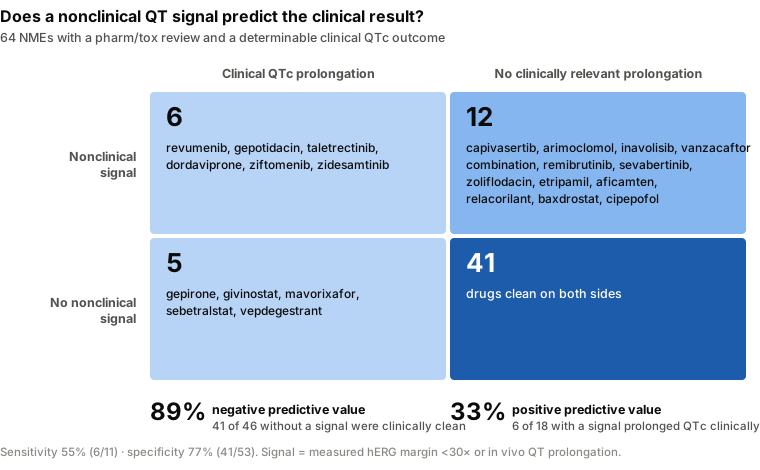
The grid covers the 64 drugs with a determinable outcome on both sides. The other 17 reviewed drugs had an indeterminate clinical outcome (16) or no nonclinical QT data (1).
Sensitivity was 6/11 (55%), specificity 41/53 (77%), positive predictive value 6/18 (33%) and negative predictive value 41/46 (89%).
Concordant positive (6): revumenib, gepotidacin, taletrectinib, dordaviprone, ziftomenib and zidesamtinib. All six carry a QTc warning. For dordaviprone, FDA explicitly read the 4-fold hERG margin as consistent with the positive clinical result 2015.
Nonclinical positive, clinical negative (12): capivasertib, arimoclomol, inavolisib, vanzacaftor/tezacaftor/deutivacaftor, remibrutinib, sevabertinib, zoliflodacin, etripamil, aficamten, relacorilant, baxdrostat and cipepofol.
- Most are in vivo QTc changes at high multiples of clinical exposure. Examples are capivasertib in dogs at about twice human exposure and baxdrostat in monkeys at 50 mg/kg only 4832763.
- Etripamil is the clearest mechanistic case. A sub-unity hERG margin was offset by potent Cav1.2 block (IC50 9 nM), and QTcF fell in the clinic 25544931.
Nonclinical negative, clinical positive (5):
- Gepirone: no hERG study and essentially negative dog telemetry, so it counts as no signal under the definition above. Purkinje fibre action potentials were prolonged at ≥1 µM, an ex vivo finding the definition does not count. TQT ΔΔQTcF was 17.4 ms 127118.
- Givinostat: 90× margin; QTc prolongation only at the 300 mg supratherapeutic dose 582.
- Mavorixafor: functional margin about 30×, but a hERG binding margin of about 6×. FDA noted that hERG data did not explain the delayed QTc effect 9053882.
- Sebetralstat: lower-bound margin about 72×. Monkey telemetry was negative, but the reviewer could not rule out QTc potential 1926.
- Vepdegestrant: hERG IC50 not reached; QTc signal found in the phase 3 QT substudy 5232.
Indeterminate clinical outcome (17):
- Mostly oncology alternative QT studies without placebo control, for example zongertinib and sonrotoclax 45785185. For sonrotoclax, FDA could not exclude a mean effect above 20 ms despite a benign hERG and dog profile, and proposed indirect mechanisms 5185.
- The single nonclinical-unknown drug is acoltremon.
Lifecycle flow: nonclinical signal to clinical approach to postmarketing action
Same denominator (n=81).
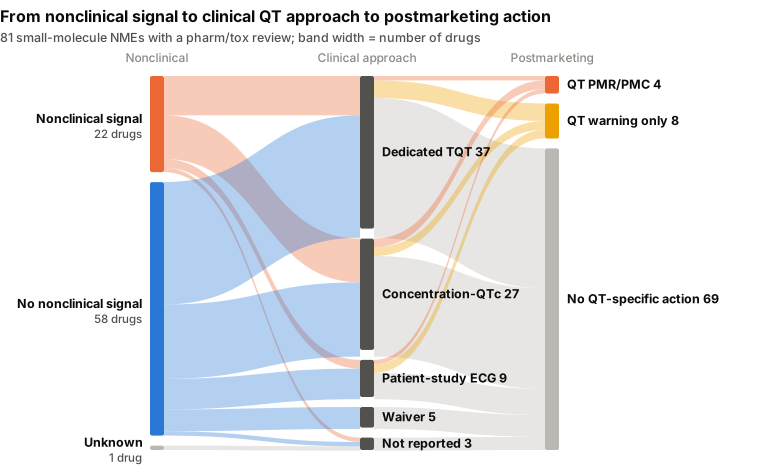
Three patterns stand out:
- Waivers track clean nonclinical profiles. All five waivers in the reviewed set went to drugs with no nonclinical signal.
- A nonclinical signal did not push sponsors toward TQTs. Signal-positive drugs were slightly more likely to use concentration-QTc than a TQT (10 vs 9). That reflects the oncology share of this group.
- A nonclinical signal made a postmarketing QT action more likely. Of the 22 signal-positive drugs, 6 (27%) ended with a QT label warning or PMR, against 6 of the 58 signal-negative drugs (10%). The signal-negative six include gepirone, givinostat and mavorixafor, so a clean nonclinical package did not rule out a QT warning.
Illustrative drugs
- Revumenib (approved November 2024) 53: every stage of the lifecycle was positive.
- Nonclinical: hERG block by parent and M1 (about 12×), QTc increase in dogs, and rabbit wedge torsade scores consistent with the hERG margins 15551571.
- Clinical: pooled patient concentration-QTc in place of an infeasible TQT, predicting 26.5 ms at steady-state Cmax 15664261.
- Postmarketing: a long-term cardiac-death PMR 4136, and a boxed warning for QTc prolongation and torsade de pointes added in October 2025 42934289.
- Gepotidacin (approved March 2025) 68: a hERG IC50 of 1.31 mM gave about a 52× margin. Wedge QT prolongation was attributed to hERG block, and conscious monkeys showed QTc prolongation 16121614. The TQT showed ΔΔQTc of 12 ms at 1,000 mg and 22 ms at 1,800 mg, and the drug carries a QTc warning 17264346.
- Etripamil (approved December 2025) 64: a hERG margin below 1× would normally be alarming. Cav1.2 block dominated, QTcF decreased clinically, and FDA agreed that no further QTc assessment was needed 25544931.
- Gepirone (approved September 2023) 113: no hERG study was conducted, and the dog telemetry was essentially negative 127. The TQT showed ΔΔQTcF of 17.4 ms, and FDA required a QTc PMR plus ECG monitoring in labeling 11834593424.
- Orforglipron (approved April 2026) 2: FDA agreed before submission that phase 1 concentration-QTc plus an integrated nonclinical risk assessment could substitute for a TQT if high clinical exposure was covered. The IRT accepted a negative conclusion 51135112.
- Acoramidis (approved November 2024) 95: phase 1 concentration-QTc plus integrated nonclinical assessment under E14 Q&A 5.1 replaced a TQT. FDA accepted this even though the major acylglucuronide metabolite was covered to only 0.5-fold clinical exposure 42174220.
- Ziftomenib (approved November 2025) 15: hERG and Cav1.2 IC50s were similar (about 1.6 and 2.8 µM), which FDA's modelling read as lower torsade risk 2123. The IRT still concluded concentration-dependent QTc prolongation from a sparse-sampling patient analysis that FDA accepted as a TQT alternative 49792118.
- Camizestrant (approved September 2026) 13: had no FDA review in the corpus, so it is outside the concordance set. It launched with a boxed warning about QTc-prolonging co-medications and a PMR to characterize peak and trough QTc effects 32443245.
Interpretation caveats
- Margin basis: margins are taken as stated in reviews. A few were calculated against total rather than unbound Cmax (for example sulopenem and levacetylleucine), so bucket placement near the 30× and 100× boundaries is approximate 14001102.
- "Indeterminate" clinical outcomes mostly reflect FDA declining to conclude "no effect" from uncontrolled patient studies, not evidence of prolongation.
- Coverage: the nonclinical and concordance figures cover 86% of the cohort. The most recent approvals are under-represented until their reviews are posted to Drugs@FDA.